
Written by Joanne Thornton Cissel Doyle ~2007
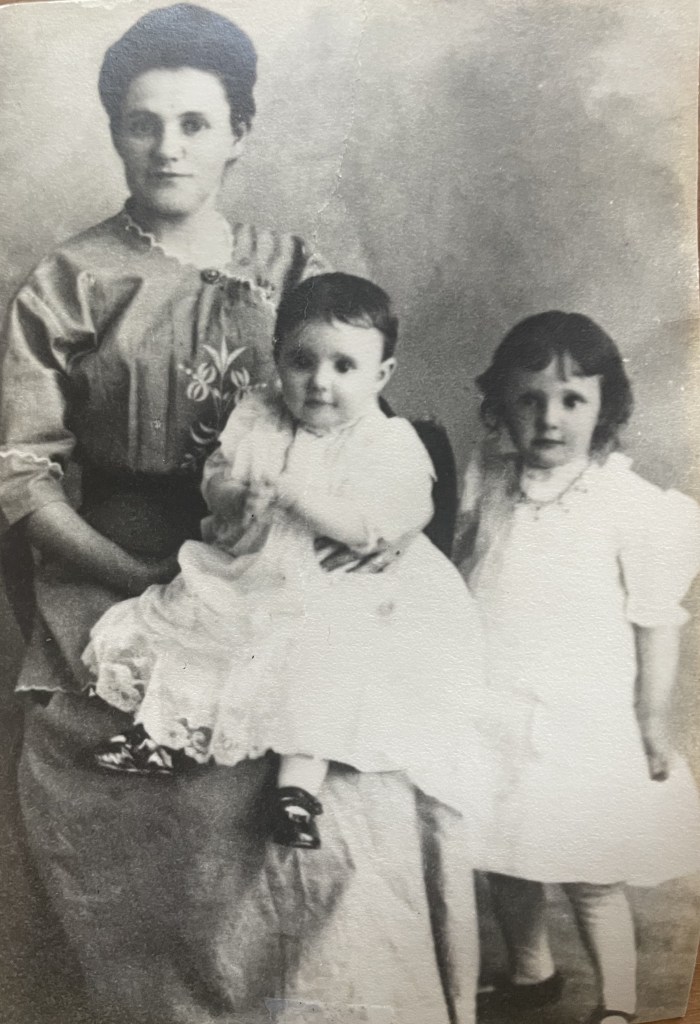
My Mother (baby in picture above)
My mother, Pauline Ganley Thornton, was born on February 15, 1910 on a farm in Silver Hill, Prince Georges County, Maryland. She was the first child born to loving parents, Savilla and Samuel Edwin Thornton. Her father, who was called Ed, had been a teacher in Fayette County, Ohio, but worked for the Department of Agriculture in Washington, D.C. His father, James Dickey Thornton, was a personal friend of President McKinley. Both Savilla and Ed had been married before. Savilla was married to Howard Hyatt and had three children: Fremont, Wootten, and Helen. Ed was married briefly to a woman that he met at the Chicago World’s Fair in 1893.
When Polly was 1 1/2 years old, on September 20, 1911, a second daughter, Alice, was born to Savilla and Ed Thornton. Polly and Alice had happy childhoods and especially enjoyed going barefoot in the summers and playing outside on their large farm. In addition to working for the Department of Agriculture, their father raised vegetables that he sold in Anacostia.
When Pauline was only 7 years old, tragedy struck in the form of illness. Her 39 year old mother, who had been sick for several years, died of tuberculosis. On the day that she died, she asked Polly to go over to the neighbor’s house for an orange. When Polly returned, her mother had had a coughing spell and had passed away. Perhaps she knew that she was dying and didn’t want her daughter to be home. In just a year, Samuel Edwin Thornton would also be dead. He died of colon cancer at age 61. Both Savilla and Samuel Edwin are buried in unmarked graves at Bells Methodist Church on Allentown Road in Camp Springs, MD.
Because he knew that he was dying, Ed had contacted relatives and the two little girls were each adopted by aunts of their parents. Polly went to live in Buckeystown, MD with Altha and Alice Specht and their three teenaged sons: Lewis, Walter, and Paul. Altha worked as a janitor for the Methodist church next door, and for many years, he also worked in the canning factory in Buckeystown.
Alice went to Duchess, a town in Dover County, New York State to live with her Aunt Hattie and Uncle Philip Havins and their four sons. Over the years, the girls didn’t see much of each other, but they did write letters.
Polly’s life in Buckeystown was very different from her life with her parents. Her aunt, who adored her sons, did not understand girls. Everyone wanted Pauline to be a little lady, but she was a tomboy. She was never allowed to go barefoot again and not allowed to climb trees. She was told over and over that she must change her ways.
Of course, she went to school which was located at the opposite end of Buckeystown from the Specht’s house. She walked the mile from the Specht’s house and the mile back home each day. Actually, people said that Polly never walked but always ran from place to place. She even ran home and back to school each day at lunchtime. It was no wonder that she was very skinny in those years.
The two room school had a wood stove for heat. Although there were electric lights, there was no bathroom or running water. They children used outside toilets—one for the boys and one for the girls. Each day several of the children were allowed to go to a house near the school to get a bucket of drinking water. It had one dipper which everyone used.
Polly made friends easily and was a good student. There were eight students in her class, five girls and three boys. At recess they played baseball and games like drop the handkerchief and farmer in the dell.
The Specht’s expected a lot from her: she helped with the vegetable garden, gathered the eggs from the chicken house, washed the dishes, and helped clean the eleven room house. One day when she was asked once too many times to empty the foul-smelling spittoon, Polly dug a hole and buried it in the backyard. In the summers she would make one of two trips each day down to the center of Buckeystown to the grocery store, post office, or the creamery. One of the storekeepers had a large metal can of peanut butter, and when he wasn’t looking, Polly would get a delicious finger full!
.Her greatest desire was to have a bike of her own. She sometimes borrowed a bike from Dorothy Nichodemus, an older, wealthier girl who lived across the street. Unable to afford a bicycle, Polly’s aunt did get her a pair of roller skates, making her the happiest child in town that day. She spent hours skating up and down the main street of Buckeystown.
As there was no television or radio and hardly anyone had a car, Polly’s favorite pastime was reading. She read all of the books in her house, at Dorothy’s house, and in the church library. Attending church services was the mail social activity for the Specht family. They went to the church which was located right next door on Sunday morning, Sunday evening, and usually on Wednesday evenings.
Polly attended Frederick High School and graduated in 1927. Fortunately, Polly’s father had put aside enough money so that she could attend Hood College, a small woman’s college in Frederick. Those years at Hood were probably the happiest time of her life. She met young women from all over the east coast; many remained friends throughout her adulthood. Alice, Polly’s sister who was living in New York, invested her inheritance in the stock market, and when the market crashed, she lost it all.
Polly graduated from Hood in 1931 with a degree in French. The country was in the midst of the depression, so Polly realized that she needed a skill that would get her a job. Therefore, she enrolled in Strayers Business College and learned shorthand, typing and other skills needed in an office. Upon graduation from Strayers, she was hired to teach business courses at Lisbon High School in Howard County, MD. She taught there for six years.
Polly was attracted to one of the other teachers, a good looking young man who taught agriculture. This man, Chester Cissel, asked her to teach him how to type. He went to her classroom after school for these typing lessons, and a romance bloomed. Polly and Ches started “courting”, met each other’s parents, became engaged, and were married on April 14, 1938 in the Buckeystown Methodist Church.
Images of Mom
- Her brown eyes and glasses
- Ironing and looking out the dining room window
- Paying bills at the dining room table
- Joy at watching birds at the feeders
- Hanging up the wash
- Cooking fried chicken
- Singing sweetly in church
- Whistling tunes at home
- Lying across her bed face down to test
- Reading the newspaper
- Taking off her glasses to read fine print
- Reading books in French
- Reading to us children at bedtime
- Her wake up calls on school days
- Her girdle with long stays
- Her house dresses, hose, and comfortable shoes
- Her fine, curly hair
- Her white teeth
- Putting “her face on” before going out
- Using cold cream at night
- Freezing and canning produce from the garden
- Smiling sweetly and waving as we would leave
- Her crooked fingers and wedding band
- Her toes padded with corn protectors
- Talking on the phone with Helen and Aunt Libby
- Watching Masterpiece Theater
- Helping me with French and Latin homework
- Watering her African violets
- Wearing aprons
- Tenderly holding her grandbabies
 Deep Thoughts on Higher Ed and Life