
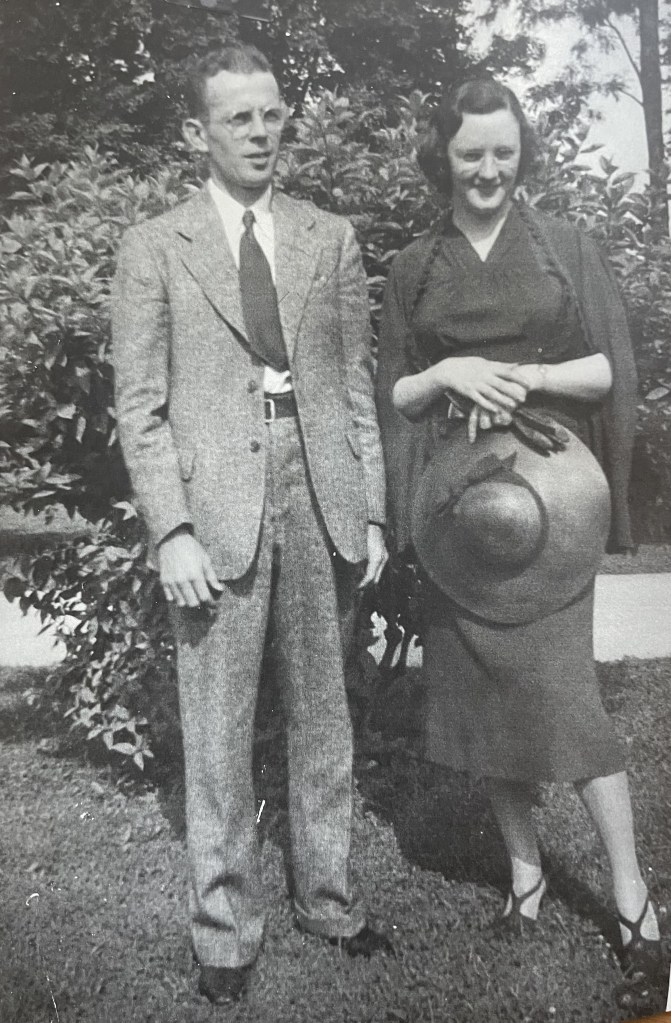
written by Joanne Thornton Cissel Doyle ~2007
My Father’s Story
The chapters of my life begin and end with my family’s moves—from farm to farm and sometimes farm to city. It wasn’t so much that we were migrants—my dad couldn’t find which part of the agriculture field suited him best. Over the years, he worked as a farmer, a milk inspector, an ag teacher, an assistant county agent, a farm manager, a fertilizer salesman, and for 20 years as Queen Anne’s County Extension Agent. Shortly before his death at the age of 84, he handed over his duties as a farm manager and agricultural consultant.
My dad, Chester Marvin Cissel, grew up on a farm on Tridelphia Road near Glenelg in Howard County, Maryland. His parents, Philip Belt Cissel and Ella Barbara Iglehart were married on October 9, 1901. My dad was the 5th of six boys and he had one younger sister. The oldest son, Philip Augustus, was born in 1902, followed by Paul Iglehart in 1906, Willis Lambert in 1907, Roger Hampton in 1909, Chester Marvin in 1911, Edwin Iglehart in 1913, and Ella Elizabeth (Libby) in 1916. Enoch Marvin Cissel, Uncle Marvin, my grandfather’s older unmarried brother, and Ann Elizabeth Iglehart, Aunt Minnie, an unmarried sister of my grandmother, lived with the family.
Dad’s parents were hard working farmer people. Life revolved around the chores of the dairy farm year: plowing and planting in the spring, making hay all summer, harvesting in the fall, and tending to the livestock all year long. There were cows to milk and horses, pigs and chickens to tend to. The women cooked, cleaned, sewed, did laundry, and preserved the fruits and vegetables. My grandmother liked to paint with oils and in her free time, she created small pictures of flowers, farm animals, and rural scenes.
Church was an important part of the family’s life. My grandparents were devout Methodists who believed that dancing, card playing and smoking were sins. The family attended the Glenelg Methodist church on Sundays. They prayed often and loved the old hymns. Neighbors were treated as extended family. Their near neighbors on Tridelphia Road were also dairy farmers. The Bandels, the Andersons, and the Cissels were a team that met peak labor needs on each other’s farms.
As soon as they were old enough to help out, Dad and his brothers were expected to pitch in and work on the farm. At an early age, they learned how to milk the cows, feed the pigs and chickens, and handle the horses which were used for plowing the fields and pulling the hay wagons.
My dad and his younger brother, Ed, were the best of friends. In fact, Dad waited a year before starting school so that they could be in the 1st grade together. As they got a little older, they became known as rascals. One day when their teacher drove by in her Model T Ford, Ed threw his textbook at her car. He might have gotten away with the insult if the book hadn’t become stuck on the rear bumper of the car. When the boys got home from school, they were met by a disgruntled teacher and their embarrassed parents.
On some mornings, the boys had to check their rabbit traps before going to school. One morning, they found a skunk in one of the traps—a skunk which sprayed them in anger. When they arrived at school, the teacher was not amused and sent them home to get cleaned up.
Chester and Ed loved baseball and played on the high school team. Ed was the pitcher and my dad was the catcher.
In the early 1900’s, tragedy struck the Cissel family twice. The second son, little Paul, lived for only seven months, passing away in January of 1907. Twelve years later the soldiers returning from World War I brought influenza home with them. Both of my grandparents, the oldest son, Philip, and the little girl, Libby, became quite ill. My dad and his brother were sent to stay with Aunt Susie and Uncle Claude. Eighteen year old Philip, pride of the family as he was handsome, bright, and loving, died on January 9, 1919. Libby was so ill that they waited several days before holding Philip’s funeral, in case they would be burying 2 children. Dad remembers seeing the coffin in the parlor and how the family dog wouldn’t leave the room. Libby did survive and my ailing grandparents would learn of their oldest son’s death only after his funeral.
One of my dad’s most vivid memories occurred one evening soon after Philip’s funeral. He saw his father kneeling in the hay barn, which was dimly lit by an oil lantern. His dad was deep into prayer.
In addition to working on the farm, the Cissel boys belonged to the 4-H Club. Dad went to Chicago while in high school to show his winning cows. Dad and Ed also loved baseball and played on the high school team; Ed was the pitcher and Chester was the catcher.
When Dad finished high school, he decided to go to college. In order to get the needed tuition, he worked for 2 years as a milk tester for the USDA. Then he left home and entered the University of Maryland. He lived and worked at the campus “Barns” and joined Alpha Gamma Rho, an agricultural fraternity. It was hard to him to be away from home and he wrote to his mother often, asking for news of the farm and family.
My dad played both soccer and baseball at the University of Maryland. During one baseball game, he suffered a deep cut in his leg when a player on the opposing team slid into home plate. As his leg didn’t heal properly, amputation was considered, but the doctors were successful in applying leeches to clean up the wound.
According to Albin Kuhn, a college classmate who later became Chester’s brother-in law, “Ches was a serious student who kept busy reading and studying. He showed little interest in coeds and purely social activities. He was well liked on campus, probably because his quiet yet outgoing personality resulted in an abundance of friends on campus. Like all his brothers, he had a strong interest in helping others—in their welfare.”
Ed decided not to attend college and stayed home to help run the family farm. When he was only 20 years old, he married a teacher, Beatrice Streaker. Roger said that my dad cried bitterly on Ed’s wedding day as he had “lost” his best friend. Ed and Bea purchased a farm on US Rt. 40 just east of Cooksville. Ed’s parents sold their farm on Tridelphia Road and moved in with Ed and Bea. Unfortunately, Uncle Ed developed tuberculosis but continued working until the illness forced him to bed. Sadly, he died in 1942 at the age of 28.
When my dad graduated from the University of Maryland with a B.S. degree in agricultural education, he was hired to teach agriculture at Lisbon High School near his home in Howard County. It was there that he met and fell in love with Polly Thornton, the pretty typing and shorthand teacher.
My Mother’s Story
My mother, Pauline Ganley Thornton, was born on February 15, 1910 on a farm near Silver Hill in Prince Georges County, Maryland. She was the first child born to loving parents, Savilla and Samuel Edwin Thornton. Her father, who was called Ed, had been a teacher in Fayette County, Ohio, but moved east to work for the Department of Agriculture in Washington, D.C. His father, James Dickey Thornton, was a personal friend of President McKinley. Both Savilla and Ed had been married before. Savilla was married to Howard Hyatt and had three children: Fremont, Wootten, and Helen. Ed was married briefly to a woman whom he had met at the Chicago World’s Fair in 1893.
When Polly was 1 1/2 years old, on September 20, 1911, a second daughter, Alice, was born to Savilla and Ed Thornton. Polly and Alice had happy childhoods and especially enjoyed going barefoot in the summers and playing outside on their large farm. In addition to working for the Department of Agriculture, their father raised vegetables that he sold in Anacostia.
When Pauline was only 7 years old, her carefree life on the farm came to an abrupt end. Her 39 year old mother, who had been sick for several years, died of tuberculosis. On the day that she died, she asked Polly to go over to the neighbor’s house for an orange. When Polly returned, her mother had a coughing spell, hemorrhaged and passed away. Perhaps she knew that she was dying and didn’t want her daughter to be home. In just a year, Samuel Edwin Thornton would also be dead. He died of colon cancer at age 61. Both Savilla and Samuel Edwin are buried in unmarked graves at Bells Methodist Church on Allentown Road in Camp Springs, MD.
Because he knew that he was dying, Ed had contacted relatives and the two little girls were each adopted by aunts of their parents. Polly went to live in Buckeystown, MD with Altha and Alice Specht and their three teenaged sons: Lewis, Walter, and Paul. Altha worked as a janitor for the Methodist church next door, and for many years, he also worked in the brickyard in Buckeystown.
Alice went to Duchess, a town in Dover County, New York State to live with her Aunt Hattie and Uncle Philip Havins and their four sons. Over the years, the girls didn’t see much of each other, but they did write letters.
Polly’s life in Buckeystown was very different from her life with her parents. Her aunt, who adored her sons, did not understand girls. Everyone wanted Pauline to be a little lady, but she was a tomboy. She was never allowed to go barefoot again and not allowed to climb trees. She was told over and over that she must change her ways.
Of course, she went to school which was located at the opposite end of Buckeystown from the Specht’s house. She walked the mile from the Specht’s house and the mile back home each day. Actually, people said that Polly never walked but always ran from place to place. She even ran home and back to school each day at lunchtime. It was no wonder that she was very skinny in those years.
The two room school had a wood stove for heat. Although there were electric lights, there was no bathroom or running water. They children used outside toilets—one for the boys and one for the girls. Each day several of the children were allowed to go to a house near the school to get a bucket of drinking water. It had one dipper which everyone used.
Polly made friends easily and was a good student. There were eight students in her class, five girls and three boys. At recess they played baseball and games like drop the handkerchief and farmer in the dell.
The Specht’s expected a lot from her: she helped with the vegetable garden, gathered the eggs from the chicken house, washed the dishes, and helped clean the eleven room house. One day when she was asked once too many times to empty the foul-smelling spittoon, Polly dug a hole and buried it in the backyard. In the summers she would make one of two trips each day down to the center of Buckeystown to the grocery store, post office, or the creamery. One of the storekeepers had a large metal can of peanut butter, and when he wasn’t looking, Polly would get a delicious finger full!
.Her greatest desire was to have a bike of her own. She sometimes borrowed a bike from Dorothy Nichodemus, an older, wealthier girl who lived across the street. Unable to afford a bicycle, Polly’s aunt did get her a pair of roller skates, making her the happiest child in town that day. She spent hours skating up and down the main street of Buckeystown.
As there was no television or radio and hardly anyone had a car, Polly’s favorite pastime was reading. She read all of the books in her house, at Dorothy’s house, and in the church library. Attending church services was the mail social activity for the Specht family. They went to the church which was located right next door on Sunday morning, Sunday evening, and usually on Wednesday evenings.
Polly attended Frederick High School and graduated in 1927. Fortunately, Polly’s father had put aside enough money so that she could attend Hood College, a small woman’s college in Frederick. Those years at Hood were probably the happiest time of her life. She met young women from all over the east coast; many remained friends throughout her adulthood. Alice, Polly’s sister who was living in New York, invested her inheritance in the stock market, and when the market crashed, she lost it all.
Polly graduated from Hood in 1931 with a degree in French. The country was in the midst of the depression, so Polly realized that she needed a skill that would get her a job. Therefore, she enrolled in Strayers Business College and learned shorthand, typing and other skills needed in an office. Upon graduation from Strayers, she was hired to teach business courses at Lisbon High School in Howard County, MD. She taught there for six years.
Polly was attracted to one of the other teachers, a good looking young man who taught agriculture. This man, Chester Cissel, asked her to teach him how to type. He went to her classroom after school for these typing lessons, and a romance bloomed. Polly and Ches started “courting,” met each other’s parents, became engaged, and were married on April 14, 1938 in the Buckeystown Methodist Church.
Polly and Ches’s Early Years of Marriage
In the first years of their marriage, my parents lived in Bel Air where Dad worked as assistant county agent for Harford County. Their first child, Mary Alice, was born in Baltimore on March 18, 1939.Then they moved to Centreville where Dad held the same position for Queen’s Anne’s County. Next they moved back to the western shore where Dad was assistant agent for Frederick and Carroll counties. I was born on November 13th 1941, just before World War II began. To get an agricultural exemption and avoid being drafted, Dad decided to become a farm manager in Reston, Virginia at the Sunset Hills Farm owned by the Bowman family. Sunset Hills was the dairy farm on the premises of the Virginia Gentleman Whiskey Distillery. My brother, Edwin Iglehart, was born in 1943 while we were living at Sunset Hills.
Our next move was to another Fairfax County farm, Dairylou, located between Floris and Chantilly. Dad was the farm manager of this large dairy farm. My younger brother, Chester, Jr. was born in 1945. My earliest memories are of Dairylou.
 Deep Thoughts on Higher Ed and Life