

Loved this section of an article by Mitch Colver, Vice President and Associate Provost for Engagement & Retention, American Public University System, on How GenAI is Forcing an Inevitable Ability/Efficiency Trade-Off
“…there is a prevalent concern among my academic colleagues that student use of GenAI will produce cognitive atrophy—the reality that delegating work to a machine will, for most students, undermine the core function of academic rigor: to produce gains in their human competence.
I freely admit that academic atrophy of certain human abilities in the era of GenAI is inevitable, yet I don’t share my colleagues’ sense of concern. Here’s why:
This is not the first time that human abilities have been widely forfeited in exchange for some efficiency.
As Vaughan Bell documented in an article for Slate, the tendency for older generations to doomsay about rapid technological proliferation is practically tradition, even among some of humanity’s most well-respected minds. Bell writes that even “Socrates famously warned against writing because it would ‘create forgetfulness in the learners’ souls, because they will not use their memories.’”
We are all familiar with a more recent example: When pocket calculators were first introduced, critics lamented that kids would lose their ability to do complex math.
Such anxieties about calculators seem quaint 60 years in retrospect, but few can argue that a real loss has actually occurred, as the ability for mental arithmetic in the average human being is probably not as sharp now as it was before. However, here we are, a generation later and the Fields Medal (a kind of Nobel Prize for Mathematics) is still being given out regularly. Indeed, the mental energy once spent mastering arithmetic is now often redirected to skills more relevant to today’s technological and scientific challenges such as coding, data analysis or working out the finer points of quantum computing.
While perennial skepticism for every next big thing seems inevitable, history also shows us that, when confronted with transformative technology, humans actually adapt, innovate and ultimately thrive, despite an obvious loss of associated human abilities. Here are a few cardinal examples:
The Typewriter & the Depletion of Reflective Writing
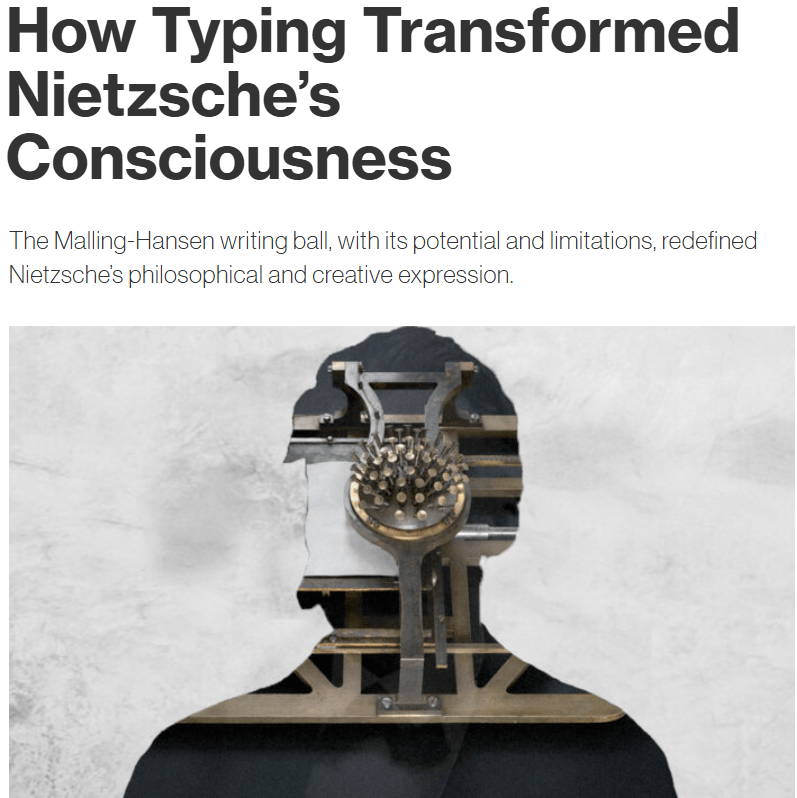
When the typewriter first debuted, writers like Friedrich Nietzsche argued that handwritten text had an irreplaceable quality—a reflective depth that typewritten text simply could not replicate. Forced to switch to a typewriter as his eyesight failed him, Nietzsche observed with frustration that his writing style had actually depreciated as a result. He remarked that the mechanical nature of typing seemed to influence the rhythm and content of his thoughts, making his prose more abrupt and abridged. He argued that writing by hand allowed ideas to flow more thoughtfully, while typing was comparatively “impersonal … It deprives the piece of work of its pride, of the individual goodness and faultiness … that is to say, of its little bit of humanity.”
Looking back, many of us might readily agree that pre-typewritten texts do feel more contemplative and carefully crafted, denser and more reflective, but no one today really cares enough to go back to writing prose by hand (barring some few). Typing is faster, more efficient and ultimately more practical. The convenience outweighs the perceived loss. In other words, this is not the first time that human abilities have been forfeited en masse in exchange for some efficiency (all while most of us don’t seem to notice or care).
The Phonograph and the Elimination of the Vocal Cord in the Common Citizen
Following the proliferation of the phonograph, Congress determined the technology was of special interest and requested testimony from John Philip Sousa—former head of the United States Marine Band and famed composer of “Stars and Stripes Forever”—about the potential harm of these newly available “talking machines.” In his testimony, which proved prophetic, Sousa passionately mourned the loss of a world where the only way humans could experience music was to produce it themselves—live.
“These talking machines are going to ruin the artistic development of music in this country. When I was a boy … in front of every house in the summer evenings, you would find young people together singing the songs of the day or old songs. Today you hear these infernal machines going night and day… We will not have a vocal cord left.” (John Philip Sousa, Testimony Before U.S. Congress, 1906.)
His prediction was eerily accurate. Today, most of us rely on streaming services and professional artists to produce our musical experiences, and fewer people than ever sing or play instruments for personal enjoyment. My parents (b. 1940/1941) confirm that in their youth (when the phonograph and radio were still not yet present in every home), people really would sit on their porches in the evenings and sing. For my part (b. 1985), I have no single memory of any neighbor sitting outside in the evenings to sing the songs of the era. Sousa’s prediction came true.
While I believe most of us can see this as a genuine loss, I don’t know anyone who is about to give up on Spotify and jaunt out to their porch to belt out their favorite tunes. Our new normal is just too aesthetically efficient compared to the former status quo. In other words, this is not the first time that human abilities have been forfeited en masse in exchange for some efficiency, even if the loss can be appreciated as significant.”
 Deep Thoughts on Higher Ed and Life