
These are what I consider the Key Findings on College Worth from Gallup-Purdue Index (2015)
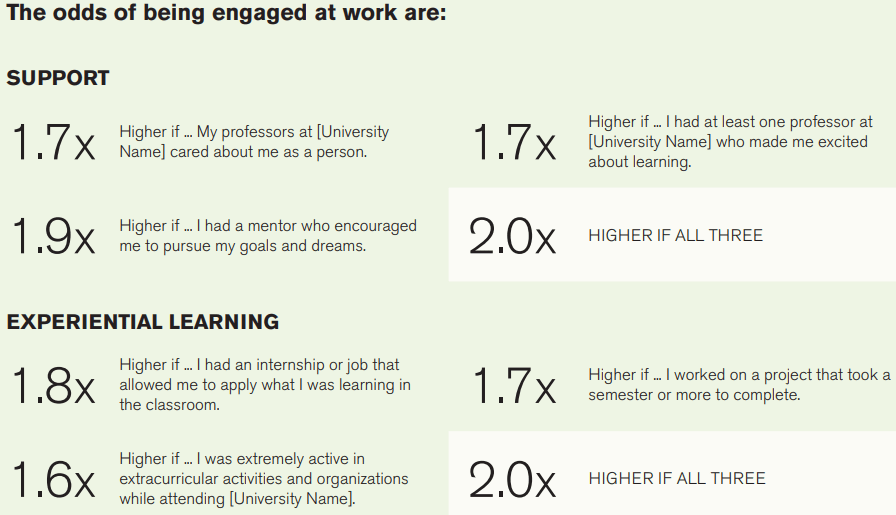
The Gallup-Purdue Index results reaffirmed the importance to students of supportive relationships with faculty and staff. If employed graduates strongly agree that 1) they had faculty and staff who cared about them as people, 2) they had at least 1 professor who made them excited about learning and 3) they had a mentor who encouraged them to pursue their goals and dreams… their odds of being engaged at work nearly double.
Graduates’ strong agreement with these three indicators of positive faculty and staff relationships also make the odds 1.4 times higher that they score well in all five dimensions of well-being assessed in the survey: purpose, social, financial, community and physical.
In 2014, Gallup and Purdue University developed a student-focused approach for evaluating their experiences at institutions of higher education in the U.S. The idea was to rely not on the vague impressions of high school counselors and officials at peer universities, but on the opinions of those who had actually received their education at U.S. universities. The result was the Gallup-Purdue Index, which assessed alumni perceptions of their undergraduate experiences and how those experiences relate to their well-being and job quality later in life.
Gallup and Purdue based the 2014 inaugural report on a survey of a representative sample of more than 29,000 alumni from across the U.S. with a bachelor’s degree or higher. This second report was based on a similar survey comprising a nationally representative sample of more than 30,000 alumni.
The 2014 Gallup-Purdue Report found that the type of school alumni went to — public or private, small or large, very selective or less selective — was far less likely to be related to the quality of alumni’s lives after they graduated than specific experiences they had in college.
Relationships Most Affect Graduates’ Perception That Their Education Was Worth the Cost
This study used a logistic regression model to assess the influence of various collegiate experiences on the likelihood of alumni to report their education was worth the cost. The analysis accounts for graduates’ employment status and amount of student loan debt.
Supportive and motivating relationships with faculty and staff are crucial to undergraduates’ college experience. All universities need to strongly emphasize the quality of the interactions faculty and staff have with students to maintain their promise of a valuable college education to prospective undergraduates. In many cases, quality interactions mean finding innovative ways to make faculty and staff more accessible and students’ interactions with them more meaningful. In the longer run, it may mean shifting the institution’s culture to give faculty and staff more incentive to make a talent for engaging students and supporting learning outcomes a more important part of hiring criteria for educators.
Describing a 10-year study with students and alumni of Hamilton College in a 2014 New York Times interview, Dr. Daniel F. Chambliss, coauthor of How College Works, noted, “Students who had a single dinner at a professor’s house were significantly more likely to say they would choose the college again. In learning to write, it made a lasting difference if students had at least one experience of sitting down with a professor to go over their work, paragraph by paragraph; for the students it was someone serious saying their writing was important.”
Universities should consider more ways to foster formal and informal mentoring relationships. Brandon Busteed, executive director of Gallup Education, highlighted the pivotal role of career mentors for college students, arguing that programs such as those that recruit alumni as mentors do not need to be costly, but they can make a powerful difference in more effectively engaging both students and alumni.
Quality relationships, rather than simple interactions, change graduates’ perceptions of their college experiences. It may be surprising that conducting a research project with a professor, for example, does not significantly relate to alumni perceptions that their education was worth the cost. Simply participating in such a project says little about the benefits students are deriving from it; in many cases, they may be assigned to mundane tasks and receive little focused attention from the professor leading the project. Unless such experiential learning opportunities have explicit objectives for improving students’ understanding of subject matter, they may do little to boost alumni engagement with the university.
Many universities invest in state-of-the-art fitness facilities, dining halls and posh dormitories to provide a more attractive environment for undergraduates. While graduates might have appreciated those amenities at the time, in the long run, they may have been better off paying less money for college but having better relationships with those who could help them carve out a vision for their future and map a course for long-term success
Making College Worth It
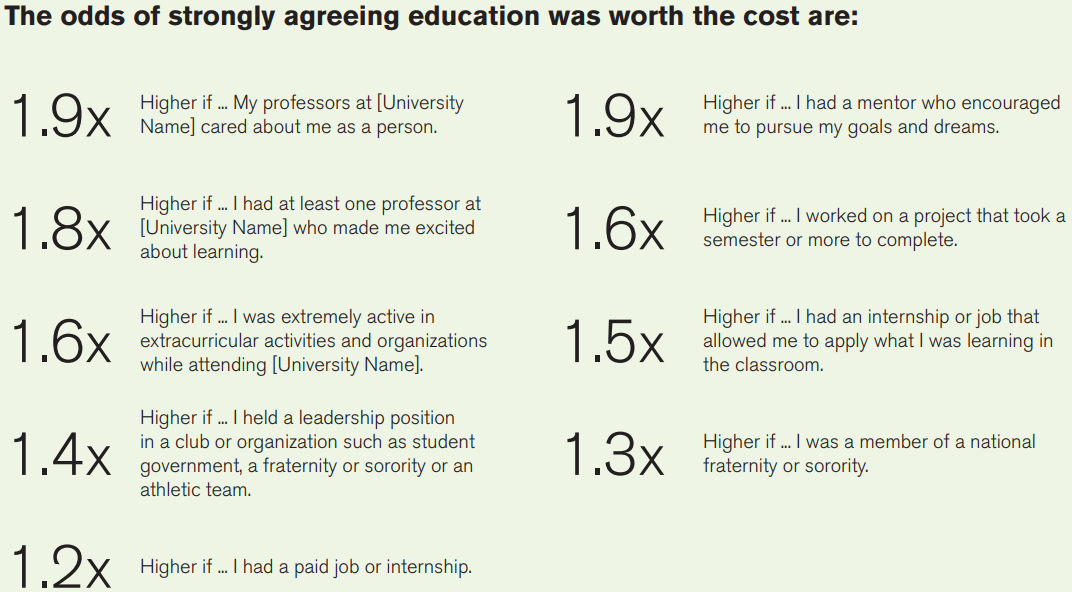
• Graduates who strongly agreed with any of three items measuring supportive relationships with faculty or staff were almost twice as likely to strongly agree that their education was worth the cost. These relationships hold even when controlling for personality characteristics and other variables such as student loan debt and employment status that could also be related to graduates’ perceptions that college was worth it.
• If graduates strongly agreed that they had any of three experiential learning opportunities — an internship related to their studies, active involvement in extracurricular activities or a project that took a semester or more to complete — their odds that they strongly agree that their education was worth the cost increase by 1.5 times.
• However, whether recent graduates participated in a research project with a faculty member is unrelated to their opinion that their education was worth the investment. This suggests that it is important to assess the quality of faculty members’ interactions with students rather than simply tracking participation in such projects.
Information primarily taken from the report: Great Jobs, Great Lives: Experiences and Perceptions of College Worth
 Deep Thoughts on Higher Ed and Life