

Taken from Oriard, M. (2014). Chronicle of a (Football) Death Foretold: The Imminent Demise of a National Pastime?. International Journal of the History of Sport, 31(1-2), 120-133. Michael Oriard, was a walk-on player for the University of Notre Dame and then played for four seasons as an offensive lineman for the Kansas City Chiefs.
After retiring from football, he earned his PhD at Stanford and became a professor and later Associate Dean at Oregon State University. He has written 8 books about sports, 6 about football.
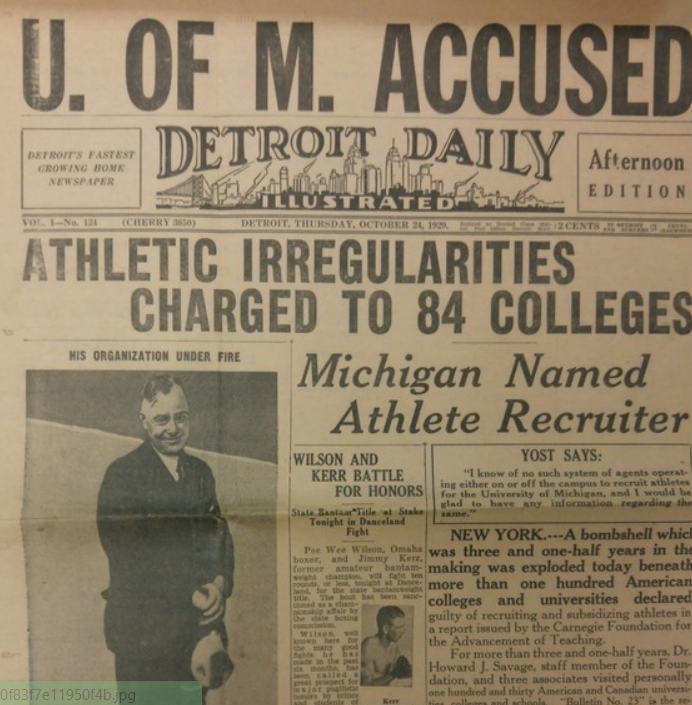
“…by the 1920s the practices of recruiting and subsidizing were so deeply embedded in college football that eliminating them had become virtually impossible. In October 1929, the Carnegie Foundation issued its landmark bulletin on college athletics, which reported that just 28 of the 112 institutions examined did not in some way engage in recruiting and subsidizing football players.
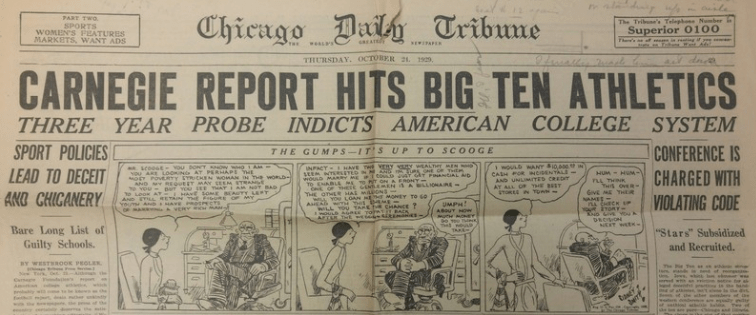
The Carnegie report was mostly met by the press and the public with a collective shrug, less denial than, as the sportswriter Westbrook Pegler put it, a waste of time, “substantiating conditions which have been commonly known to exist.” With no external pressure to reform, most university leaders also shrugged, and continued their football business as usual.
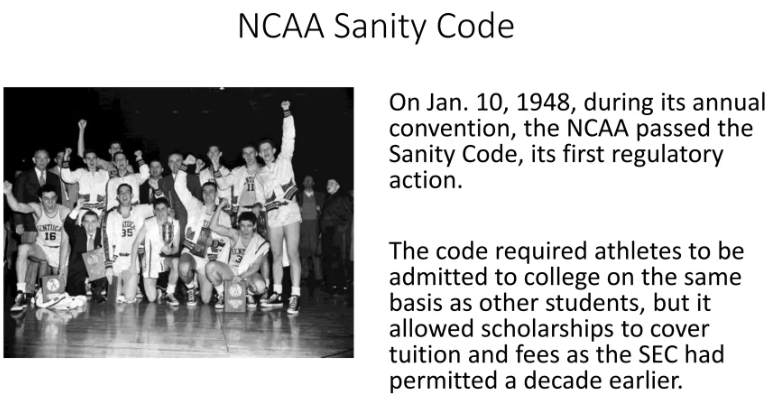
The Big Ten (actually Big Nine by this time) and Pacific Coast Conference seemed to win the war against professionalism (or for hypocrisy) at the 1948 NCAA Convention with the passage of the so-called Sanity Code, requiring financial aid to be need-based and earned by work “commensurate with the services rendered.”
But the victory proved short-lived, and by 1956 the NCAA for the first time embraced the concept of the athletic scholarship. The term “scholarship,” however, as opposed to something like “athletic grant,” preserved the necessary fiction of amateurism on new terms. For the next seventeen years, an athlete could not lose his “scholarship” for athletic incompetence or even for quitting the team.
That changed, decisively, at the 1973 NCAA convention, where the membership replaced the standard four-year scholarship with a one-year grant, renewable at the coach’s discretion.
(In short,) the fissure has been there from the beginning, when “amateurism” was first defined on economic rather than academic terms. And this definition has been contested since the beginning, long before the emergence of millionaire coaches and an entertainment industry generating billions.
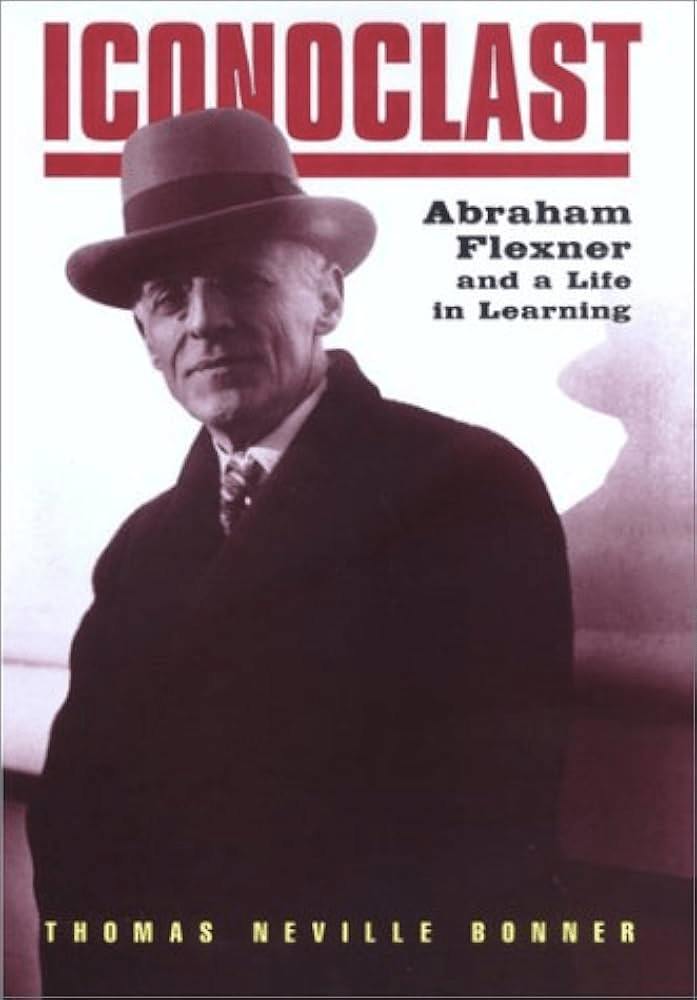
“No university in America has the courage to place college athletics where everyone knows they perfectly belong.” Abraham Flexner, ~1930
 Deep Thoughts on Higher Ed and Life