

I began this reflection in an effort to encourage others to purchase and read Brittney Wardlaw’s new book about her time at Baylor University. However, in an effort to not only celebrate her work, but reflect on similar experiences I had at Baylor, I decided to attempt to frame her stories in the framework of organizational leadership I observed while there.
I worked at Baylor University from August 2010 to January 2022. I worked there longer than any of the other 14 universities where I have worked, studied and taught. For most of my time there, I served as a dean in Student Life; but I also taught in the Schools of Education and Business, worked in Academic Affairs, served on many cross-divisional committees/groups.
Of all the universities where I have been, Baylor University has by far had the most loyal and ardent faculty, staff, students and alumni. Baylor’s admissions and recruitment staff used techniques of persuasion that seemed to perfectly embody best practices of behavioral economics and effectively communicate the uniqueness of Baylor. As someone overseeing new student orientation, I inherited and mainly admired the efforts of the New Student Programs staff to create connection, friendship, a sense of belonging among new students in multiple pre-August experiences before they moved onto campus.


Overall, I have never seen a university so intentionally integrate its history into the active and celebrated traditions of the university today. This includes 2 live bears living on campus, the entire first year class invited to run across field before the football game and sit in the best seats, and almost all students travelling 2.5 hours to the birthplace of Baylor to learn about its history and be given their Line Jersey as they walk underneath the original columns of the campus. Baylor is home to the oldest Homecoming in the nation which is anchored by the longest Homecoming Parade in the nation along with other traditions (e.g. Pigskin) benchmarked by other universities annually.
I loved so much about Baylor University and I am immensely proud of my time there. I met and worked with many amazing people at Baylor, many of whom are still dear friends today.

I used to tell parents and new students that Baylor is to universities as Disneyworld is to theme parks. Baylor is the best of the best in so many ways (which does result in a high cost). To be the best requires commitment to a culture and values that are strictly adhered to, especially when anything threatens to compromise that Disney-like image. During my 11.5 years at Baylor, I studied and honestly, admired, an adherence to the Baylor “brand” that was unlike anywhere I had ever seen.
Baylor was the first place I had been where the Chief Marketing Officers reported directly to the President. Our Marketing folks were involved in crafting almost any statement that came from the administration. This is by no means wrong – but the attention Baylor gave to its image was way ahead of its time in the higher education world. Until Baylor, I had never understood that it could be an institutional choice as to when certain conflicts would be addressed.
For example, when I discovered in 2012 that Baylor’s three founders were all slaveholders, I was asked to keep that fact to myself until the administration wanted to address that. When I identified that Baylor’s Human Sexuality statement was drawn from Baptist documents that described the roles of men and woman as complementary, not egalitarian, I was asked to focus on the positive changes being made to the statement.
It was no secret that Baylor’s leaders were almost all white and promotions and hires in the administration would come from “friends of (fill in name of a President or Provost).” In light of this, when I began to meet with rising staff leaders of color to encourage them and show them places where their leadership might be more welcomed, I was scolded for this.
When I led a committee to bring multiple nationally-known authors and speakers to campus on a wide range of diversity issues, I had to lean on the protection of my VP and several others from attacks on our efforts to educate our staff to the rapidly changing face of student diversity.
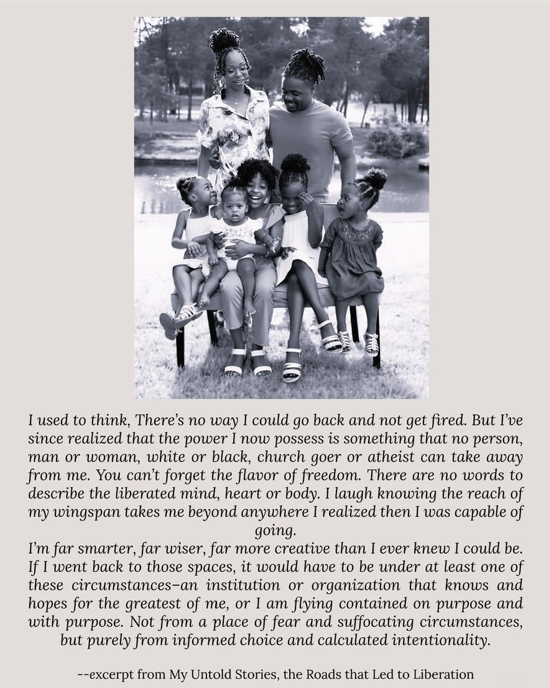
I could go on, but my original intent was to tell interested readers that in the last 5 days I ordered and finished reading Brittney Wardlaw’s new book; My Untold Stories: The Roads that Led to Liberation.” Brittney is the only person I know out of a host of good-hearted others who “mysteriously” disappeared from the university, who did not take the monetary offer for silence and instead chose to speak about the injustices she faced at Baylor.
I am grateful that Brittney took to the time to write out her stories and share them with those of us wondering why university leaders were not recognizing her many strengths and giving her the opportunity to impact change at a place where she was, in my mind, a perfect fit for what we needed. I was most impacted by a section in Brittney’s book about the impact of insecurity on our behavior. The people I saw do what I would consider unethical things at Baylor University, were often motivated not by inherent meanness, but their fear that they would lose their jobs/salaries/friendships/etc. if they acted against the behemoth that is Baylor. I don’t know how many times I heard friends tell me and write me how thankful they were that I was not afraid to step into silence around certain issues and attempt to stimulate meaningful dialogue. I know I made many mistakes in how I attempted to do this, but I am proud of my work at Baylor and the encouragement that has come from others while I was there.
Thirty years ago (1994), the New York Times’ bestseller, Built to Last: Successful Habits of Visionary Companies, by Jim Collins and Jerry Porras, was published. The extensive research done in the book highlighted several characteristics of great companies that had withstood the test of time (over 50 years old), significantly outperformed the stock market, and overcome challenge after challenge.

One of the most controversial chapters in the book was a chapter entitled, “Cult-like Culture,” and it described how these incredible companies maintained their status by religiously protecting a corporate culture defined by:
“i. Fervently held ideology
ii. Indoctrination (management enforces it)
iii. Tightness of fit (of those it hires)
iv. Elitism (proud of being part of it)”
These four principles of long-lasting, high achieving companies were synonymous with my experience at Baylor University. If you were a part of the family, every door was open to you and everyone made you feel at home. The strength of the alumni connection to Baylor is extraordinary. Students talk about Baylor in terms analogous to their places of worship.
But if you walked too often against the grain at Baylor, you transitioned to a place of purgatory that left you wondering how to return to the good graces of your Baylor family. Coming from a family where speaking out was encouraged and challenging processes was expected, my ability to safely navigate conflict in a deeply Southern and Baptist community, was going to be highly unlikely. I often failed.
I will never forget these words of Collins and Porras in their Cult-Like Culture chapter, “great companies were great places to work only for those who buy in to the core ideology; those who don’t fit the ideology are ejected like a virus.” The words came back to me quickly when I read about Brittney’s challenges at Baylor. People who tried to change too much at Baylor typically became short-timers there. Sometimes they would realize on their own that they were not going to last, and other times they needed someone to tell them they would not.

The main message of Built to Last is a yin/yang that argued that truly great companies must 1) hold fast to their core values and 2) be continually open to learning new things. The balance of these potentially conflicting themes creates organizations that sustain excellence. In all the universities I have worked, I have seen this interplay of tradition vs. change. As the author George Marsden once said, churches and universities have lasted several hundred years longer than any company in our nation. At Baylor, this wrestling between the past and future is more apparent than anywhere I have been. It comes in part from the fierce loyalty to the Christian principles at the root of the university, which can at times be at odds with the desire to be one of the top universities in the nation.
As I read Brittney’s book, I hurt when I saw a friend whom I cared deeply about, fighting to honor the faith of Christian Baylor while also pushing Baylor to adapt to a world where Christianity is more than conservatism. People like Brittney and so many other friends of mine no longer at Baylor are exactly what Baylor needs to maintain its place as a visionary university. Unfortunately, the soldiers in the trenches, likely Brittney, are casualties in the struggle between tradition and change, and sadly, they are often forgotten and rarely appreciated.
In publishing this book, Brittney has reminded me and many others that she was a faithful laborer under the power of leaders who were protecting themselves and an institutional image, that would have only been much brighter if it had been open to all the gifts of its people.
Thank you, Brittney, for not only telling your story, but standing alone as one of the few people who rejected pay-offs from an institution that states it is committed to the light of truth, love for our fellow man, and service to others, but regularly operates behind the scenes by hiding from the truth, treating people without grace, and focusing on serving goals of net revenue, public acclaim, conflict-free homogeneity.
I have been at enough universities to know that most universities, if not organizations, operate is much the same manner. It is just especially sad to me when a university that claims to stand for love and truth treats so people many differently when the feel insecure or that their image is threatened.
That said, I continue to tell anyone (who has lots of money or is OK with lots of debt) that I can think of no other university in the nation that offers as robust as college experience for 18-22 year olds as Baylor University. And I guarantee anyone who goes there will discover thousands of people who do their best on a daily basis to embody the best values of the university.

 Deep Thoughts on Higher Ed and Life