
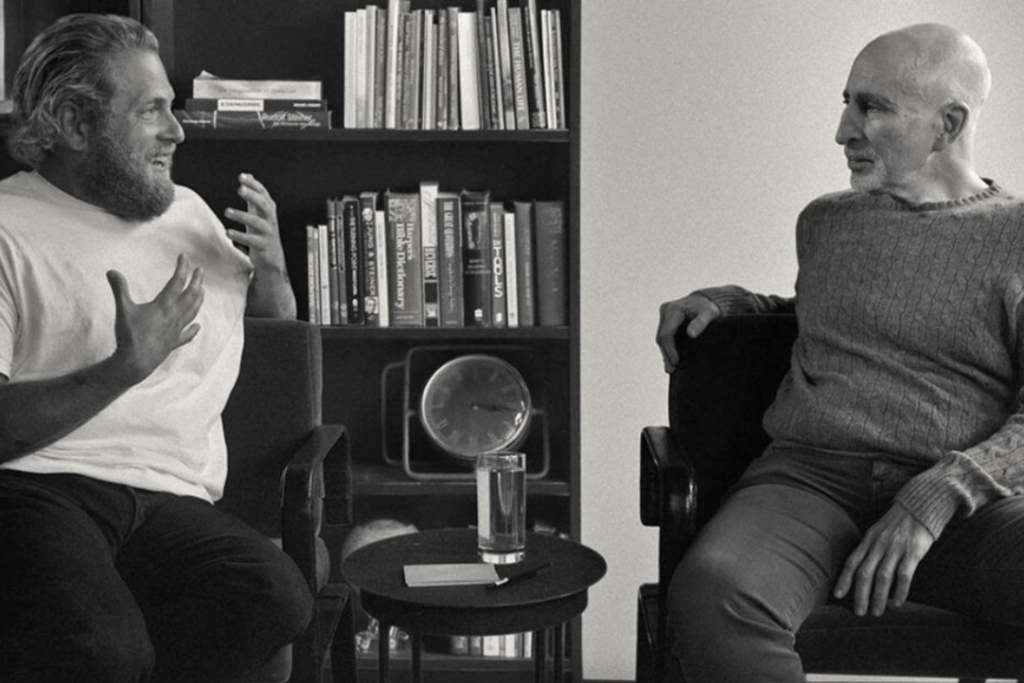
Some of my favorite quotes from the documentary I watched on 7/29/24. It is the story of actor Jonah Hill interviewing his therapist, Stutz, about the teachings and wisdom Stutz transferred to him from their time together. Thanks to Matt Hogan and his website, MoveMe Quotes, for sharing these online.
“In traditional therapy, you’re paying this person, and you save all of your problems for them, and they just listen, and your friends, who are idiots, give you advice. Unsolicited. And you want your friends just to listen. And you want your therapist to give you advice.” Jonah Hill
- “You have three aspects of reality that nobody gets to avoid. Pain, uncertainty, and constant work. Those are things you’re just gonna have to live with, no matter what. What will make you happy is the process. You have to learn how to love the process of dealing with those three things.” Phil Stutz
- “Failure, weakness, and vulnerability is like a connector… it connects you to the rest of the world because what you’re doing is giving out a signal to the world that says I need you because I can’t do this by myself.” Phil Stutz
- “Everyone in your life is imperfect, either because of something they’ve done in the past or something they can’t change in the present. Fixating on these things destroys relationships. You need a tool that allows you to accept people despite their flaws.” Phil Stutz
- “The Life Force is the only part of you that is actually capable of guiding you when you’re lost and consists of 3 things in a pyramid: The bottom, most primal level is your relationship with your physical body, the second level is your relationship with other people and at the top of the pyramid is your relationship with yourself. If you’re lost, depressed or feeling stuck, it’s important to work on your Life Force first — take care of your body, take care of your people, take care of yourself. Once you do, figuring out how to move forward becomes much, much easier.” Phil Stutz
- “The sun is always up there. The cloud is always over here, blocking the sun. If you can’t break through, you think it’s a very bad day. In fact, you think it’s a very bad life. Part X wants you to have the negative flow, so it’ll create the cloud up there so you can’t see the sun. You forget that it’s actually sunny up there. The question becomes, ‘How do you penetrate the cloud?’ And the answer is, ‘With gratefulness.’” Phil Stutz
- “The Grateful Flow is not the things you’re grateful for. The Grateful Flow is the process of creating these things. So close your eyes. Now, what you want to do is you say two or three, at most four, things you’re grateful for. The smaller the thing, the better, because it forces you to concentrate gratefulness. You wanna do it nice and slow. You want to feel the gratefulness. The next thing you do is you feel that you’re going to create another grateful thought, but you don’t. You block it. So all you feel is the force that would create a grateful thought, and as it gets stronger and stronger, you feel taken over by it. That’s the Grateful Flow.” Phil Stutz
- “A tool is something that can change your state, your inner state, immediately, in real time. It takes an experience that’s normally unpleasant, then it turns it into an opportunity. Tools change your mood and then just give you a sense of hope that won’t be your mood forever.” Phil Stutz
- “A tool is a bridge between what you realize the problem is and the cause of the problem to over here, actually gaining at least some control over the symptom. It all has to do with possibility. And not a bullshit definition of possibility. Possibility means you feel yourself reacting differently. It sounds, trite, but it’s actually the truth.” Phil Stutz
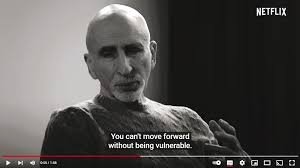
- “The driving force in this whole thing [the movie], to me, is your vulnerability. No question about it. If we’re true to that idea and you’re forthcoming with it, we really can’t go wrong. The thing is, if you wanna move forward you can’t move forward without being vulnerable.” Phil Stutz
- “The winner is not the one who makes the best decisions or looks the best, the winner is the one who works that cycle: who’s willing to take the risk, willing to act with some degree of faith, and faces the consequences — if the consequences are bad then you gotta work the cycle again. That’s as good as it gets” Phil Stutz
- “Your relationships are like handholds to let yourself get pulled back into life. The key of it is you have to take the initiative. If you’re waiting for them to the take the initiative, you don’t understand. You could invite somebody out to lunch that you don’t find interesting, it doesn’t matter, it will affect you anyway, in a positive way. That person represents the whole human race, symbolically.” Phil Stutz
- “The [String of Pearls] is probably the most important thing, motivationally, you could teach yourself. You just draw a string of pearls. There’s a line, then a circle, line, then a circle. Each one of those circles equals one action. But here’s the thing. Every action has the same value. I am the person that puts the next pearl on the string. That’s it. Just getting out of bed and doing what you have to do that day and not putting, like, a size value on the effort. They’re all the same size. This means that every large or small action in your life (brushing your teeth, deciding to end a relationship) is just that: a thing to do. You are the only person who can put the next pearl on the string. But, within each pearl is a dark spot (Stutz calls it a “turd”), which is a reminder that no effort you make will be perfect. The key is to acknowledge that and keep adding to the string anyway.” Phil Stutz
- “The highest creative expression for a human being is to be able to create something new right in the face of adversity, and the worse the adversity, the greater the opportunity.” Phil Stutz
- “The Shadow is the part of yourself you’re ashamed of — the part of you that you wish didn’t exist. You must learn to talk to your Shadow, ask it how it feels about you and ask it how it feels to be denied or avoided. In order to work with the Shadow, you have to be able to visualize it, honor it and engage with it.“ Phil Stutz
- “True confidence is living in uncertainty. To develop courage, you have to give up this illusion of future certainty.” Phil Stutz
- “The average person wants to get paid back. They want everything to be fair. They want everything to be balanced. But you’re not gonna get it from them. The way you feel you’re getting paid, the way you feel things are being rebalanced, is to get your satisfaction from the exercise [forgiveness/ letting go/ love] itself. That’s called Active Love.” Phil Stutz
- “Parkinson’s has made me aware of time. Like, really aware of it. My sense of mission, my sense of this is what I’m supposed to do, that got much stronger in me. If I don’t do that, I start to think about, ‘Oh, shit, this happened to me. What a drag.’ You know, it makes life harder. Then you go into this whole pity party thing. It’s a complete waste of time.” Phil Stutz
- “You’re not trying to become non attached. You’re trying to move towards non attachment every time you get scared of a loss. For most people, they’ve never been non attached for one second in their whole life. So even the fact that they can move towards that is helpful for them. So the goal is not to become completely non attached. No. It’s work towards no one person, place, or thing leaving you can completely take away your whole existence and your sense of wholeness.” Phil Stutz
- “Close your eyes and imagine an entire universe composed entirely of loving energy — then visualize your physical self absorbing all of that love and taking it into your heart. Then, imagine taking all of that concentrated love and emitting it onto another person or a negative experience that has stayed with you. By doing this, you can visualize yourself becoming one with the person or thing that wronged you. Do you want to be right, or do you want to create something new?” Phil Stutz
- “Radical Acceptance is the antidote to judgment — judgment of yourself, of others and of what could potentially happen in the future. It’s not about approval either. Instead, it’s about accepting all parts of yourself and allowing them to exist.” Phil Stutz
- “Most people have a hard time processing loss and grief, even before the loss occurs. There’s a potency in non-attachment — in other words, you should fearlessly pursue the things you want, but you should also teach yourself to be totally unafraid to let them go. Imagine yourself hanging from a branch. What happens when you let go? The falling is gentle – visualize your physical self falling onto the surface of the sun. Once you hit, your physical body disappears, absorbed by the sun’s tremendous energy. You’re then transformed into light — in other words, you’re everywhere and can expand as quickly as you want. Instead of grasping, all you can do is give.” Phil Stutz
- “Instead of seeing problems as an expression of a “condition” whose cause was in the past, we needed to see them as catalysts for developing forces that were already present, lying dormant inside us.” Phil Stutz
- “We’re trained as a society to expect, even demand, immediate gratification. And we have an extraordinary ability to rationalize this weakness. Instead of admitting we’re avoiding pain, we tell ourselves we’re being virtuous. We end up with a distorted worldview that makes avoidance seem right, even brave and idealistic. This is the worst sin of all—lying to ourselves. It makes change impossible.” Phil Stutz
- “It is a tragedy to die with your song unsung.” Phil Stutz
See more about how I suggest we find our Song, or Purpose, here.
 Deep Thoughts on Higher Ed and Life