
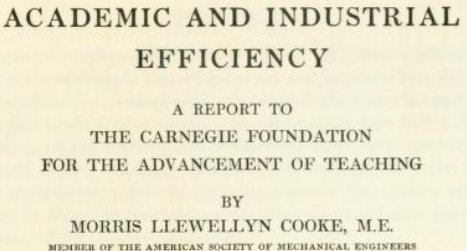
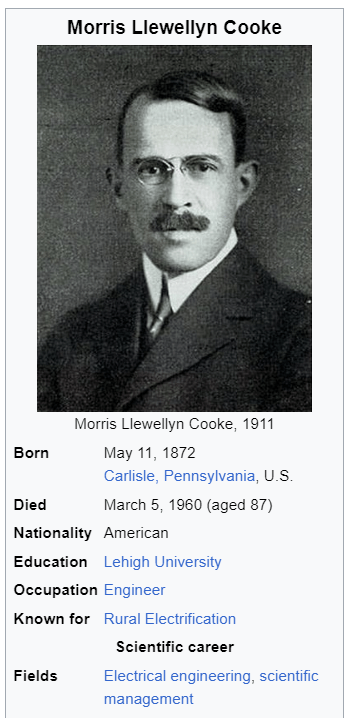
A REPORT TO THE CARNEGIE FOUNDATION FOR THE ADVANCEMENT OF TEACHING BY MORRIS LLEWELLYN COOKE, M.E., 1910
As someone who reads about and tries to improve the lack of efficiency and effectiveness in higher education on a regular basis, I was excited to find what I believe to be one of the first substantial pieces on the need, ability, and know how to improve higher education. I hope to share a few posts from this 124 year old treatise on understanding potential efficiencies in higher education.
“It is impossible to avoid the conclusion, after even a casual survey of this field, that the men connected with the colleges and universities have looked upon their functions as having very little in common with those which engage the attention of people in other walks of life; and any one making such a study as this is first of all impressed with the price that is being paid to maintain this position of isolation. This one element of the problem would be enough to account for the growth of most of the things which, in my opinion, may profitably be changed.
It is practically impossible to find any one broad problem of university government solved in the same way by two institutions. This lack of standard methods is particularly marked in the financial administration of colleges. Thus, in the matter of inventorying lands and buildings Dr. Eliot, then President of Harvard University, said; “We try to come as near forgetting the value of our lands and buildings as possible. This makes the simplest bookkeeping.”
As a result of this inquiry, the writer is convinced that there are very few, if any, of the broader principles of management which obtain generally in the industrial and commercial world which are not, more or less, applicable in the college field, and as far as was discovered, no one of them is now generally observed. At nearly every institution progress has been made along certain lines, but generally it has been a “lone fight;” one institution doing one thing and another doing another, without any of the mutual help and cooperation which is given in the business world. The colleges are not only not organized for the exchange of help and information and data, but as a rule it appears that they do not care to afford it. The broad reason for this difficulty seems to be that the records of the colleges as a whole, and of the individual departments, are inadequate, and are so lacking in uniformity that any effort on the part of one college to help another is made with too much difficulty.
At Princeton, while as a matter of practice the departments were allowed to attend to the details — and only occasionally were they upset — the most unintelligent counsel prevailed at times on matters of real moment. In other words, there were no bounds to the authority of those “higher up” when they cared to use it. One or two committees of the board of trustees had the power to enter almost every nook and corner of the educational structure. This inspection of course would be all right — excellent — if it were made for the purpose of seeing that the general policies were being carried out; but too frequently there is no permanent general policy and these acts are the promptings of personal whims or prejudices. Everyone from the president down told me that committee management was adopted because it was a democratic form of government. The result struck me as being a far cry from real democracy.
 Deep Thoughts on Higher Ed and Life